The new Hookr is live on Robinhood Chain
The short version
Who it is for. Until now Hookr was about token launches. Now you can pick the Hook Blocks for any market, RWAs included, not just a launch. Teams and holders of tokens that already trade, including tokens launched on Pons, pools.trade or any other launchpad, can open new pools for those tokens on Hookr hooks and manage liquidity after launch with the Hook Blocks their community needs, auto burn included. Launchers can open every market they launch through the Hookr coordinator, with an integrator tier of their own. Anyone launching a new token still gets Hook Blocks from day one. And builders can remix, list or integrate hooks.
- Hookr is now modular infrastructure for surfacing, composing and integrating custom Uniswap v4 hooks on Robinhood Chain.
- Two verified root hooks open every new market, Hook Blocks are fixed at creation, any quote, no flat protocol fee.
- Use the hooks or build with Hookr. WTH is live on it; v4rc's Hook Block is coming soon.
What Hookr is now
Hookr started as a launchpad with one hook per token. It is now hook infrastructure: Hook Blocks sit in a catalog, a pool remixes the ones it wants into its hook, the root hook enforces them on every swap, and the same blocks are open to anyone building on Uniswap v4 through a public catalog and an SDK.
A Hook Block is one mechanic with its own parameters; five are live (dynamic fees, Anti-Snipe, Auto Burn, LP Rewards, Nth-buy Pot) and a pool takes up to eight at creation. A hook profile is a sealed root hook at its own address: one kernel, the blocks it admits, and the router and quoter it trusts. A sealed profile never changes, so a new block ships inside a new profile, and a new profile can carry mechanics the current root cannot express, as the WTH recapture profile does. Every pool runs on exactly one profile. That is what makes onboarding a builder or a partner fast, and why the work from here is new blocks and new profiles, at pace. With the system set up this way, new Hook Blocks plug in much faster than before, so expect them to arrive at pace from here.
Two ways in: use the hooks, or build with Hookr.
What changed
Two root hooks. Every new market opens on the default root 0xb3cA29cF721380CEe8b8e4755F3865Ebc68Fe8cC, which is on Uniswap's routing allowlist so Uniswap's own interface routes through its pools, or on the arbitrage-recapture root 0xb914f955294799de4b891bd2EA8AF628Fa1c68CC, which is not yet allowlisted.
Any quote. A new token or an existing asset against ETH, HOOKR, USDG or a tokenized stock, tokenized stocks against a stablecoin included. Same hook, same blocks, keyed by quote.
No flat fee. The base LP fee goes to liquidity providers, all of it. The protocol earns a share only inside the add-on streams a pool opts into, 20% by default, frozen for the life of the pool. That share lands in a treasury forwarder anyone can trigger, and the team uses it to buy back and burn HOOKR, every buyback published on hookr.fun/token. The Auto Burn block feeds it too: 80% of its cut burns the pool's own token and the protocol's 20% is taken in the quote, so every pool that burns also burns HOOKR. The streams behind HOOKR only grow: a pool's slices are never removed, every new hooked pool adds its own, and every new root profile brings more.
Blocks that cannot move. A pool's configuration is hashed into the registry at creation and checked on every swap and liquidity add. No admin function reaches an open pool, no upgrade path, no way to pull the founding position.
Verified. All sixteen contracts of the standard profile are full-match verified on Blockscout and exact matches on Sourcify; the recapture profile's root and executor adapter are full-match verified on Blockscout. Sources and review package: github.com/Hookr-fun/hookr-contracts.
Pool fees and hook fees
The pool fee is Uniswap's LP fee, set per pool at 0.05%, 0.30%, 1.00% or a custom rate. Hook fees are the add-on blocks a pool opts into, taken on top of it.
| Fee | Kind | Who pays it | Where it goes |
|---|---|---|---|
| Base LP fee | pool fee (Uniswap LP fee) | every swap | 100% to in-range liquidity |
| Dynamic fee (above base, on large trades) | hook fee | trades that move the price | 80% to LPs, 20% to the protocol |
| Snipe tax (guard window, new tokens) | hook fee | buys during the guard | 80% to the creator, 20% to the protocol |
| LP reward cut | hook fee | buys | 80% donated to in-range LPs, 20% to the protocol |
| Nth-buy pot | hook fee | buys through the Hookr router | 80% into the pot, 20% to the protocol |
| Auto burn | hook fee | buys | 80% of the withheld tokens burned, 20% taken in quote |
Every hook fee is optional and chosen at creation. The 20% is the deployed default, capped at 50% in the contracts; a change applies only to pools opened afterwards.
Use the hooks
Provide liquidity
Add liquidity from hookr.fun/portfolio, where your positions sit, or from the Liquidity tab on any pool page. Pick a range over the depth chart, which shows the liquidity actually in the pool around the current price. Provide both assets or one; a single-asset add swaps the missing share first, then adds the position, two signatures in a row.
Six ways to LP, all plain Uniswap v4: a base-fee-only pool; a concentrated range with LP rewards on, the cut donated in the same swap to liquidity in range at that moment; full range on a dynamic-fee pool, keeping 80% of the surcharge on large trades; creator as first LP through the guard window, keeping 80% of the snipe tax on top of the base fee; single-sided range orders that fill as the price crosses them; stock and stablecoin pairs, base fee only.
Open a Hookr Pair for a token that already trades
Tokenized stocks are available for launch pairing and pool creation as well, in any combination: an RWA against another RWA, or an RWA against any token.
On hookr.fun/launch, open Create pool: it opens up to 8 Hookr pools for a token that already trades, each running the Hook Blocks you pick and opening with $10 over the full range. It takes no power over the token.
Launch a new token
Open hookr.fun/launch and pick New token. One launch opens the token in up to 8 pools at once, each on its own quote and running the Hook Blocks you pick, in one transaction, on Hookr's hook or a hook of your own. A dev buy can join the launch, and the pools' liquidity then stays locked for 7 days by default.
Trade
Every pool page has the trade panel, a native trade-by-trade price chart with candlesticks and buy and sell analytics, a holders link, the pool's standing Hook Blocks, and the exact waterfall your swap pays before you sign. Swaps go through the Hookr router or the Universal Router, and where a token also trades elsewhere the page links the other venue.
Build with Hookr
Remix Hook Blocks into your own hook
hookr.fun/builder opens on Hook Blocks: start from a preset or a remix link, set each block's parameters within the contracts' bounds, then share the board as a link or launch with it. Launch on Hookr's hook with nothing to deploy, or deploy your own hook.
List a hook in the marketplace
hookr.fun/hooks lists every Hook Block, then the hooks on today's pools and community hooks. Any Uniswap v4 hook can be listed, including one you launched on another launchpad or straight to the PoolManager: it gets a page, a decoded callback profile, an audit summary and a place next to every pool on Robinhood Chain, in front of the traders and LPs already here. Analyze the address on hookr.fun/analyze, run the audit, complete the dossier and submit; a manual review publishes it, no transaction needed. Hooks the index finds on chain already show as external hooks with their callbacks; a listing turns that row into a named page.
Integrate: agents, apps and launchers
hookr.fun/agents is "Get Hookr for your Agent": a SKILL.md an agent can load, the public JSON routes (protocol stats, pool discovery, pool APR, pools and trades), and the addresses. The hookr-sdk package on npm and the hook catalog at hookr.fun/api/hooks/catalog let any app, launcher or marketplace validate a configuration against the root's bounds, build the market-creation call, quote and swap through the router, and read pools. Partners with their own mechanics get a sealed root profile of their own; WTH's is the first.
A live example: HOOKR / POOLS
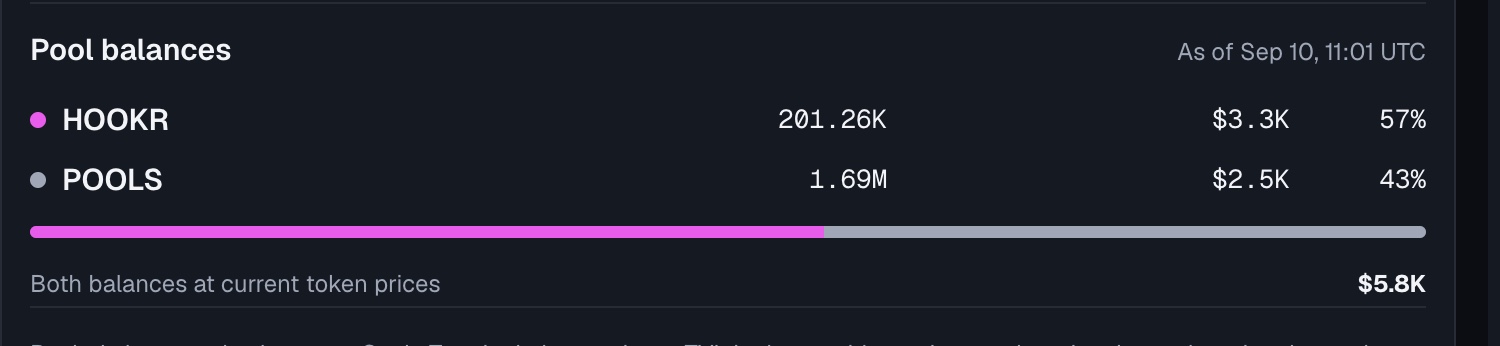
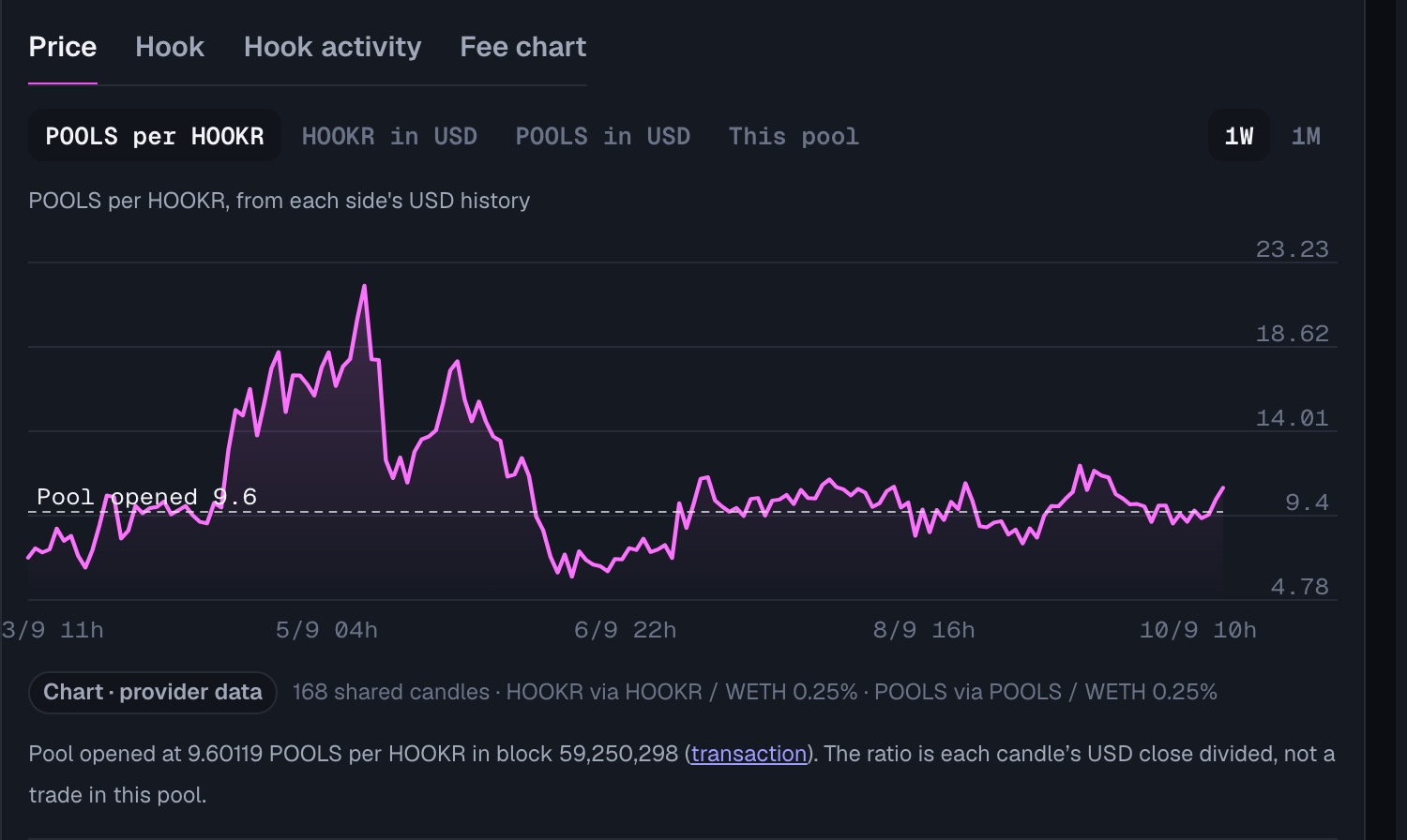
We opened the first pilot pool ourselves, with our own liquidity: we bought POOLS on the open market and opened HOOKR / POOLS on the Hookr root with auto burn at 1% and a 0.30% base fee. Pool 0x671b7c433c8e1900600ca284e09e5a7c5948af408bc4fcf5a6cbc8bd4f54f470 opened in block 59,250,298 at 9.60119 POOLS per HOOKR and sits at the top of Discover as an existing pair on the Hookr root.
It is already trading. At 11:00 UTC on 10 September it held 201.26K HOOKR and 1.69M POOLS, $5.8K at current prices, with $2.4K of volume over the trailing day across 19 trades, 14 buys and 5 sells. Every buy burns HOOKR: the hook activity tab lists thirteen burns so far, 906.13 HOOKR sent from the buyers' output to the dead address, the protocol's 20% of each cut taken in POOLS.
If you hold tokens, provide liquidity with them: any token you hold can be paired with HOOKR this way, and any pair that already trades on Robinhood Chain can get a Hookr pool with Hook Blocks of its own. Many more HOOKR pairs are coming in the next days.
Important notes
- Exact-output sells carry no protocol take; the surcharge stays with liquidity.
- A pool with any input cut (dynamic fee, guard, burn, LP reward or pot) does not support partial fills on exact-input buys; a base-fee-only pool does.
- During a new token's guard window the hook refuses liquidity from anyone but the founding position; the guard lasts at most 100,000 blocks and the pool page shows when it ends.
- Fee-on-transfer and rebasing tokens are refused at opening.
- A pool's Total APR is what it paid its LPs since it opened, annualised: a past rate, not a promise.
- Version labels on the site: Legacy for generations 3 and 4, V1 for the last launchpad generation, V2 for the new system. Hookr's labels, not Uniswap's.
- The contracts have not been audited by a third party. The review package and the evidence are public.
Who is building on it
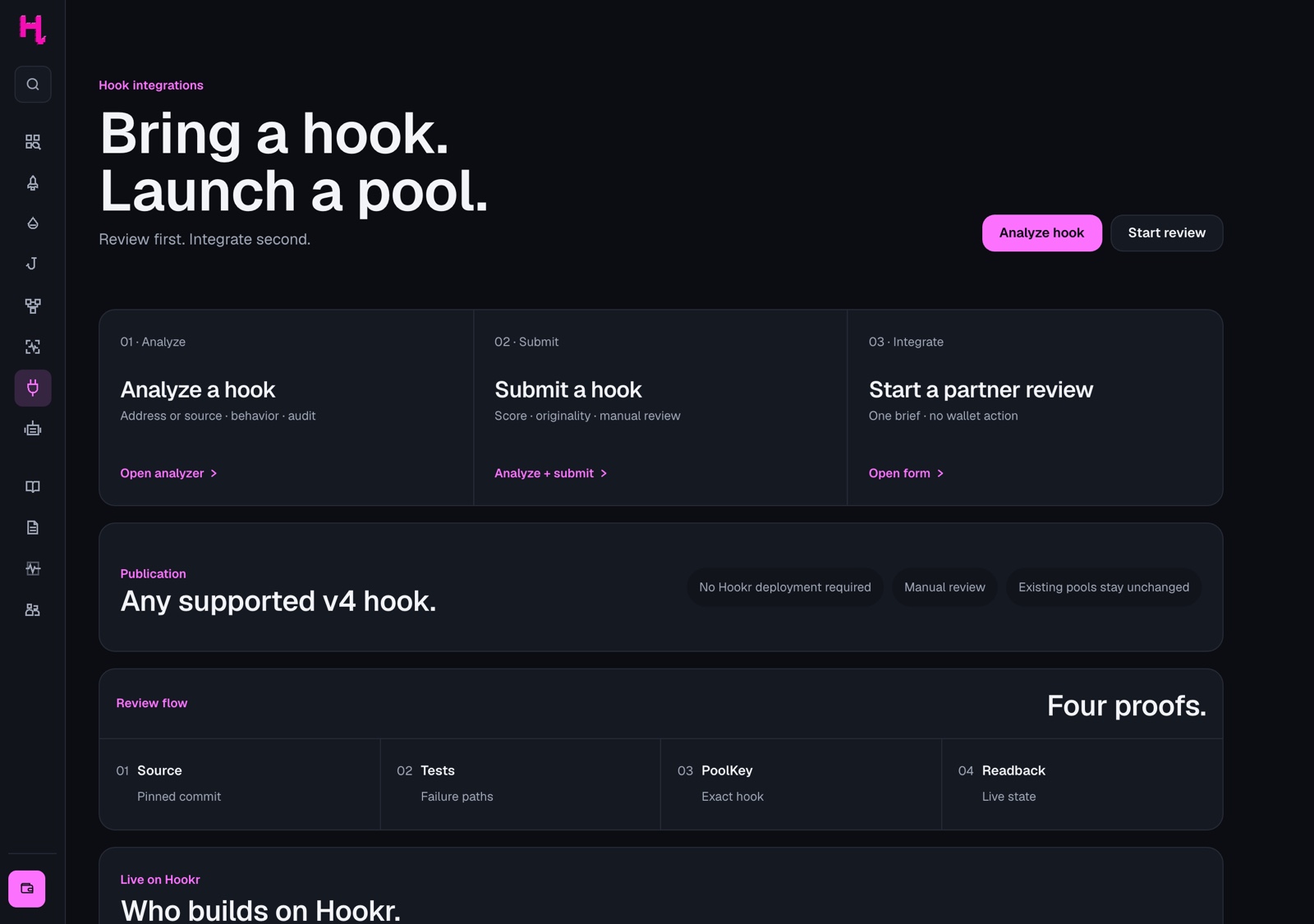
Tokens launched on Pons, pools.trade or any other launchpad can open programmable markets after launch and rally their communities around the Hook Blocks they need.
- WTH, live. An arbitrage-recapture profile: after a swap on a pool that selects it, a bounded arb recapture trade captures a realized cross-venue price gap and splits it between the pool's creator, the trader, the pool's LPs, WTH and Hookr. Its root is deployed, verified, bound to WTH's executor and sealed; three pools are open on it, HOOKR/ETH first, and the launch flow offers the recapture option for ETH-quoted pairs.
- v4rc, coming soon. V4RCADE, an arcade on Robinhood Chain where a game round sets your swap fee, has built that fee as a Hook Block for Hookr; the block is in review and runs on no Hookr pool yet.
- Tokens launched on Pons get post-launch liquidity management on Hookr: hookr.fun/launchpads tracks them, and any of them can take a Hookr hook through the existing-asset lane.
What comes next
Every new root profile brings its own streams, with no fixed limit on how many can be sealed.
- Arbitrage recapture share. 10% of every recaptured profit on pools that run the WTH profile, fixed in the arb recapture split: creator 40%, trader 20%, the pool's LPs 20%, WTH 10%, Hookr 10%.
- Directional tax profile. Buy and sell taxes as a sealed profile, with the protocol's frozen share of the tax stream.
- Lend Boost profile. Lending-backed liquidity on Hookr pools, running dynamic fees, the guard window and the directional tax with the protocol's share of those streams.
- More roots under the same stack. Further partner profiles, each a sealed profile on the same registry, coordinator, router and quoter.
- More integrator tiers. The protocol share on launches through partner launchers, at the tier the coordinator holds for each launcher.
- Tooling.
hookr-sdk1.1.1 is on npm now for the new pools on all four cores, with Wallet Cap's builders and reads (see SDK). The 0.2 line, for the earlier roots, was the one on npm then: it names both roots, opens markets on either with the arb recapture fields frozen, floors the gas on swaps against the recapture root, scans markets in bounded windows and reads every registered root from the registry. The hook catalog is live at hookr.fun/api/hooks/catalog; next an MCP server over the same package.
Where to read more
hookr.fun/docs carries the fee arithmetic as the contracts compute it, the guides for both lanes, the liquidity guide, the claims guide, the contract reference with every address, and the security pages. Contracts, review package and evidence: github.com/Hookr-fun/hookr-contracts.
A note to the community
Thank you for the early support. A small group of people believed in Hookr when it was one hook per token, tested every release and told us what was broken. This one is for you.
There are many more builders in the pipeline than the ones named here, and we cannot wait to put each of them in front of you. We have also had far more inbound than we could answer. If you wrote to us and have not heard back, that is on us, not you, and we will get to you. This new infrastructure is a big part of why we can move faster now, on all of it.
How the new Hookr works, step by step
Screenshots from hookr.fun (Robinhood Chain 4663) at a 1280 by 900 desktop viewport in the site's default dark theme, with no wallet connected. Figures are read off the screen at capture time, and each lane stops where a wallet has to sign.
Provide liquidity
hookr.fun/portfolio opens on Positions, which reads your positions from PositionManager ownership once a wallet is connected. Its Add liquidity tab finds a pool by symbol, name or address, then takes a range plan over the pool's depth chart and both assets or one; the Liquidity tab on any pool page opens the same form on that pool. Approvals are finite with a bounded expiry, and the mint is simulated before your wallet opens.
Open a Hookr Pair
A token that already trades opens its pools from hookr.fun/launch now: open Create pool, pick the token and its pair, then each pool's Hook Blocks, as Multi-pool launch describes.
Launch a token
hookr.fun/launch opens on Hook Blocks now: one launch puts a token in up to 8 pools, each on its own quote, with the blocks and their parameters fixed in at launch. Multi-pool launch and Dev buy and its lock cover each setting.
Trade
- hookr.fun/app is Discover: 77 indexed pools with block chips, fee, TVL, 24h volume, 24h change and estimated APR, HOOKR / POOLS first at 1.3%, $5.6K TVL, $2.4K of 24h volume and 8.4% estimated APR.
- The HOOKR / POOLS pool page: the frozen blocks bar with the 0.3% base fee and the 1% burn, price, TVL, 24h volume, and the pool fee set by the hook on every swap.
- The trade panel buys and sells through the Hookr router: 1000 POOLS quotes about 89.079742 HOOKR, with the base LP fee, the 1% burn cut (2 POOLS) and a minimum of 87.298147 HOOKR at 2% slippage enforced on chain, all before anything is signed.
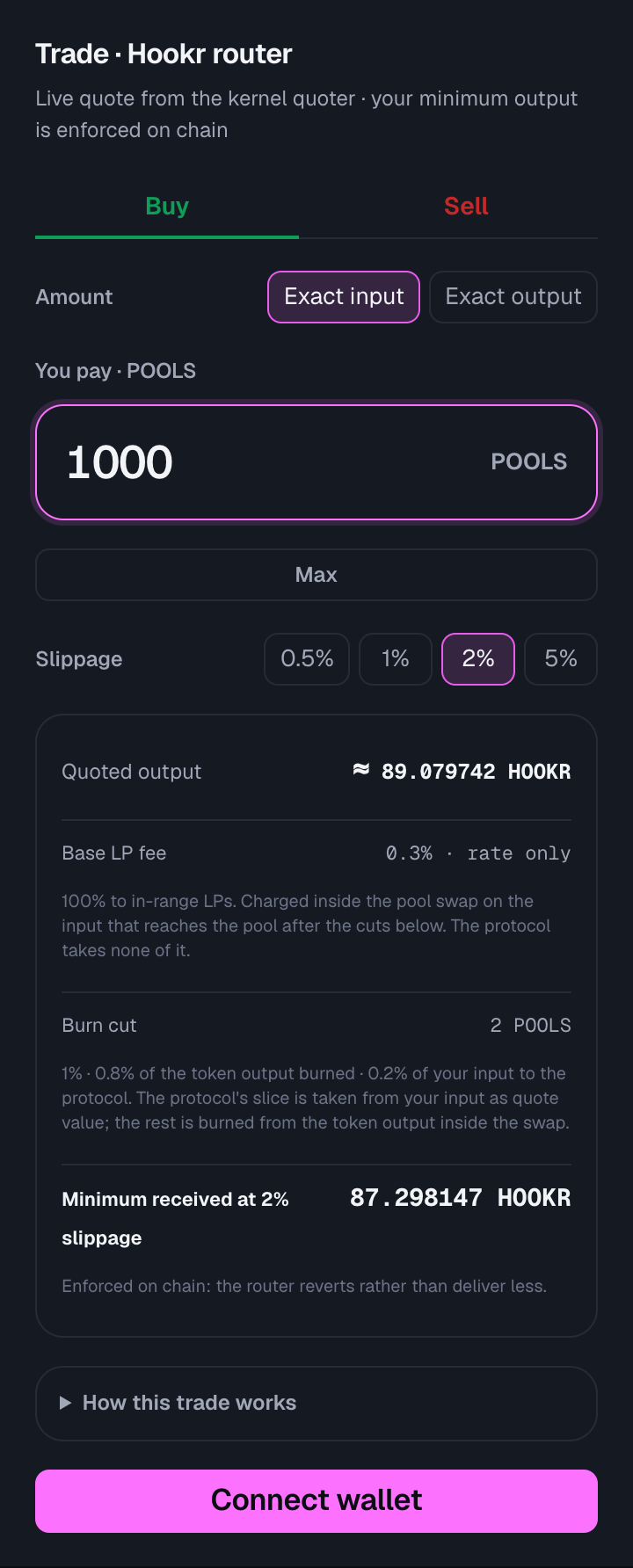
Trade panel with what a swap pays - hookr.fun/token is the HOOKR page: total burned, price, in-range depth, supply, and how value accrues.
The pool's balances, hook activity and pair history are in the launch post's live example.
Build with Hookr
- hookr.fun/builder is the Hook Blocks builder now: start from a preset or a remix link, set each block's parameters within the contracts' bounds, then share the board as a link or launch with it.
- hookr.fun/hooks lists every Hook Block with what it does and where it runs, then the hooks on today's pools.
- hookr.fun/integrations, who builds on Hookr: the integrations live today, the community integrations and the ones coming soon.
- hookr.fun/agents: one skill file under 8 KB with every deployed address and the calls to read a pool's blocks, quote and swap, provide liquidity, open a market and claim payouts; an MCP server is next.
- hookr.fun/docs: what a Hookr pool is, the two lanes, the fee model in one table, and where the code and the addresses live.